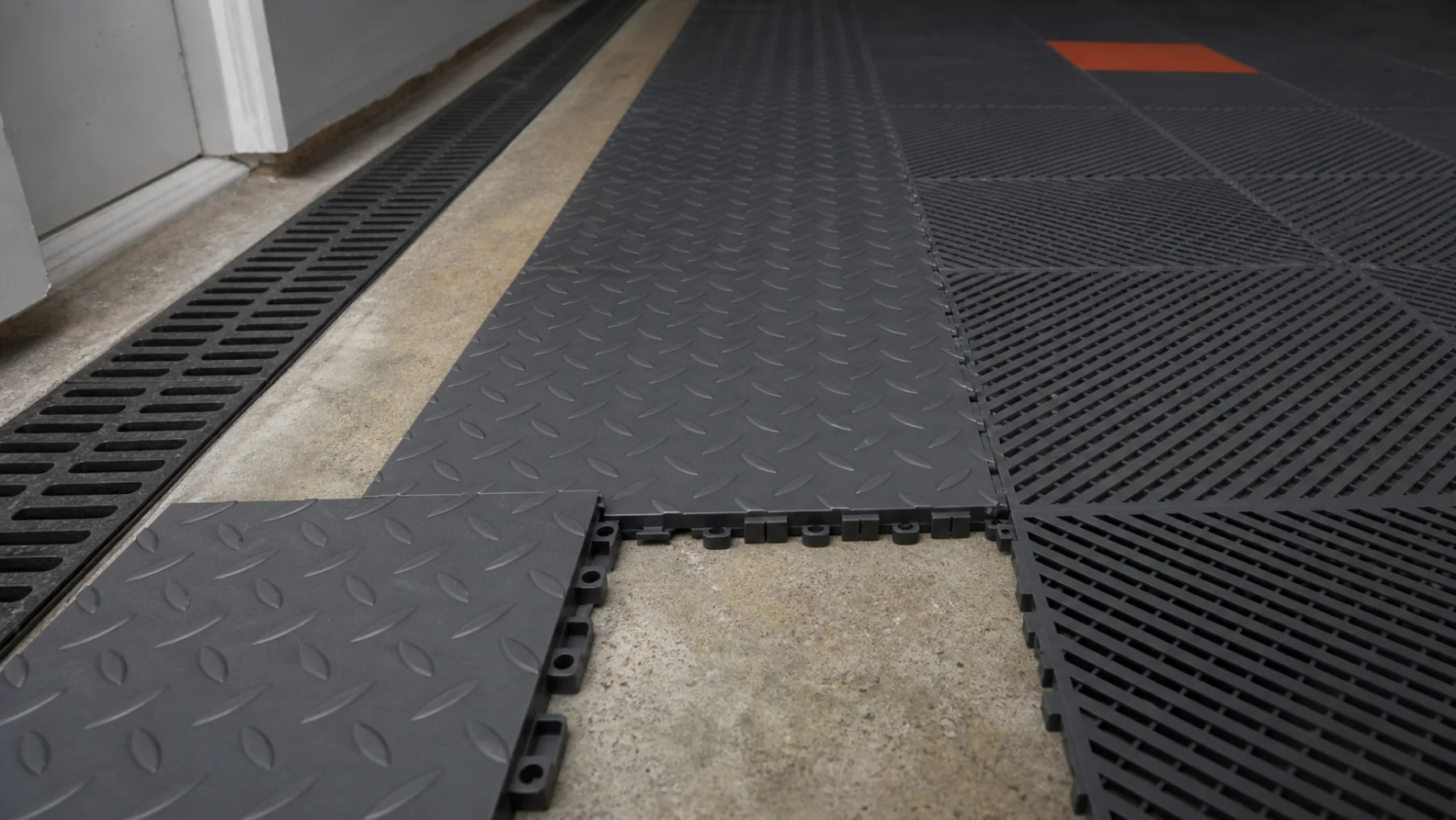
Open-profile tiles make sense for water and snow; solid-profile tiles simplify surface cleanup. Both need perimeter expansion, transition, and small-wheel planning.
Choose the profile by the mess
Open tiles let meltwater and wash water fall below the surface, keeping feet above the mess. They also let fine debris collect below and can be awkward for narrow casters. Solid tiles are easier to wipe on top but still rely on a vented substructure and perimeter detail.
Do not treat a laboratory load claim as permission to ignore point loads, jacks, lifts, or rolling-tool geometry. Ask the manufacturer about the exact use.
Installation is simple, layout is not
Tiles snap together quickly, but a clean result needs a centered layout, expansion gap, straight cuts, door-clearance check, and compatible edge ramps. Heat and sunlight can move large fields, so follow perimeter guidance.
Order a sample and roll the smallest hard caster across it. Sound, texture, gloss, and color are easier to judge in the garage than on a screen.
The moisture advantage
Tile does not chemically bond to the slab, which can make it more tolerant of moisture uncertainty and damaged appearance. It is not a moisture-remediation system. Water pathways, odor, cleaning access, and underlying cracks still matter.